For freelance designers
The number you quote isn't your price. It's your nerves.
In the two seconds after a client asks "so what would this cost?", the most anxious part of your brain picks a number, and it picks low. The Calm Quote Kit helps you decide your price tonight, in about an hour, so on the call you just read it.
16-page PDF workbook and a fillable worksheet for Google Sheets or Excel.
Sound familiar?
The client asks "so what would this cost?" and you hear yourself say a number lower than you meant.
Your price changes depending on how the call feels.
You ask "what's your budget?" hoping they'll decide for you.
You replay the quote afterwards and wish you'd said more.
If two or more of those are true, the problem isn't your skill. It's when you decide your price.
Why the usual advice hasn't fixed it
You've probably heard all of these. Each one sounds right, and each one breaks at the same moment.
The real problem is the two seconds after the client asks. You're guessing what they can afford, worrying about losing the job, and on a video call you're watching your own face while you do it. So your brain picks a number that feels safe. And safe means low.
No formula helps, because the formula isn't in the room.
A low quote doesn't stay one low quote.
It becomes the number that client expects next time. It's the number they mention when they recommend you to a friend. It quietly becomes your real rate, and raising it later means a conversation you'll keep putting off.
The method: the pre-decided price
Read your price. Don't decide it.
Pilots don't work out their takeoff speed on the runway. They calculate it before the flight, when it's quiet, and read it off a card when it counts. The runway is the worst place to do maths.
Your discovery call is your runway. So you decide your price beforehand, when nobody is watching, and put it on one page. On the call you read a decision you've already made. The kit builds that page with you in three steps.
Your floor
The lowest rate you'll ever price from, worked out from your own costs and hours. It holds whether or not you feel confident, and the worksheet flags any quote that falls below it.
Your market
A 20-minute check of what clients already pay for your exact service, and where you sit in that range.
Your packages
Three tiers built from your hours, so clients choose between options instead of haggling over one number.
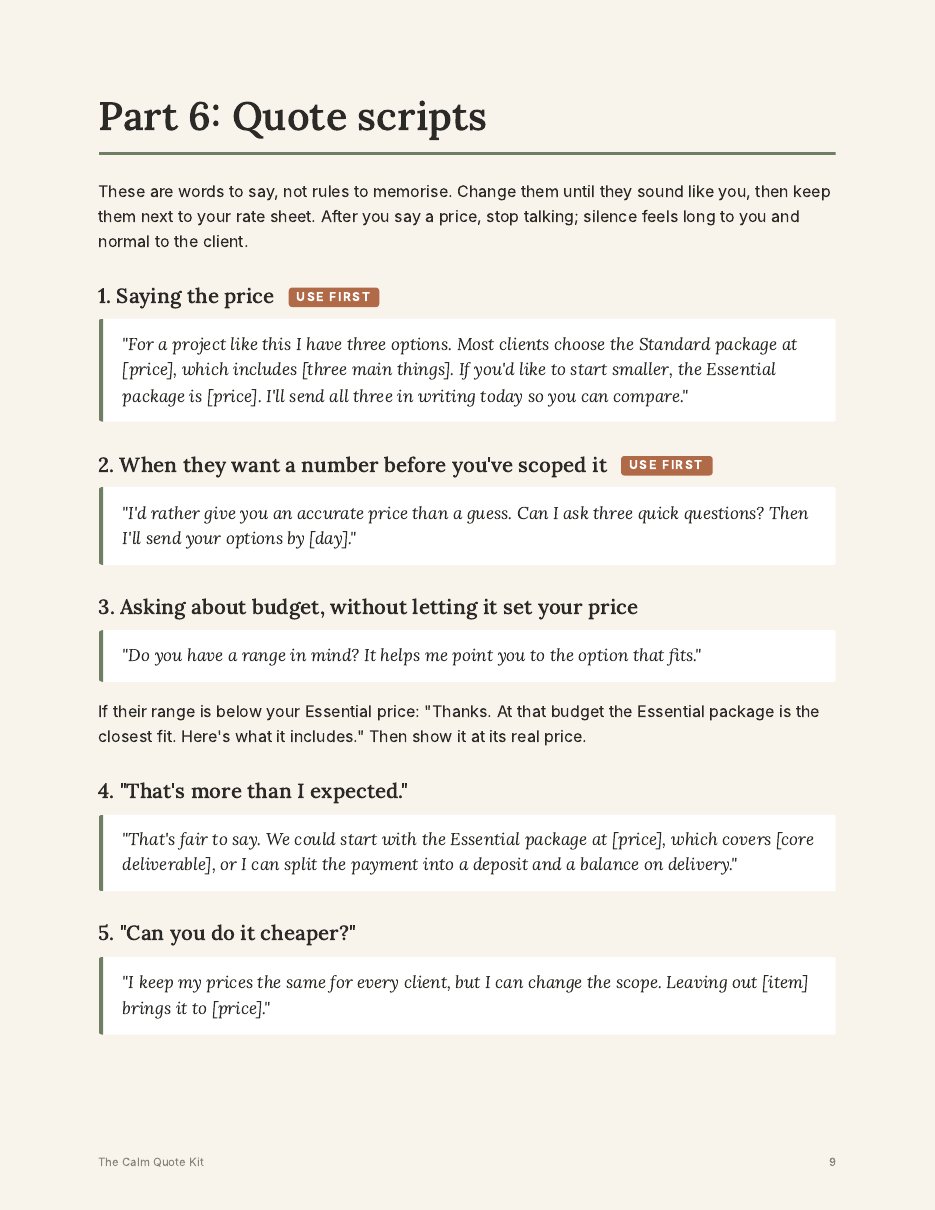
All three go onto a one-page rate sheet, with ready words for when the client asks the price, says it's too much, or mentions a cheaper designer.
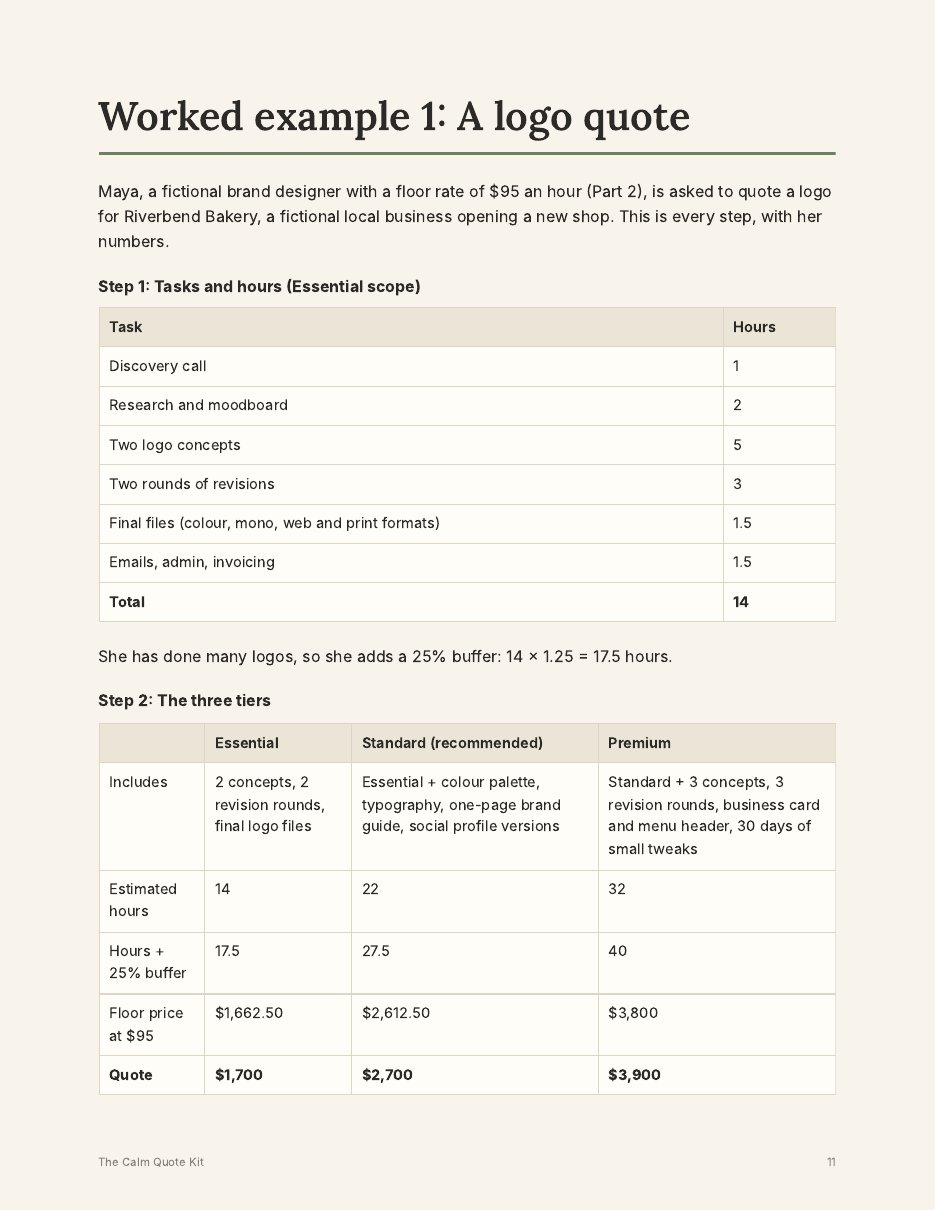
Here's what that looks like: a logo for a bakery
| Essential | Standard | Premium | |
|---|---|---|---|
| Estimated hours | 14 | 22 | 32 |
| Hours + 25% buffer | 17.5 | 27.5 | 40 |
| Floor price at $95/hr | $1,662.50 | $2,612.50 | $3,800 |
| Quote | $1,700 | $2,700 | $3,900 |
From page 11 of the kit. The designer and her client are fictional; you'll do the same with your own numbers. If she'd typed $1,900 for the Standard package, the worksheet would have flagged it as below her floor.
Try this before your next call, free: write the lowest number you'd accept on a sticky note and put it where you take calls. Don't go under it. The kit shows you how to work that number out properly.
Look inside
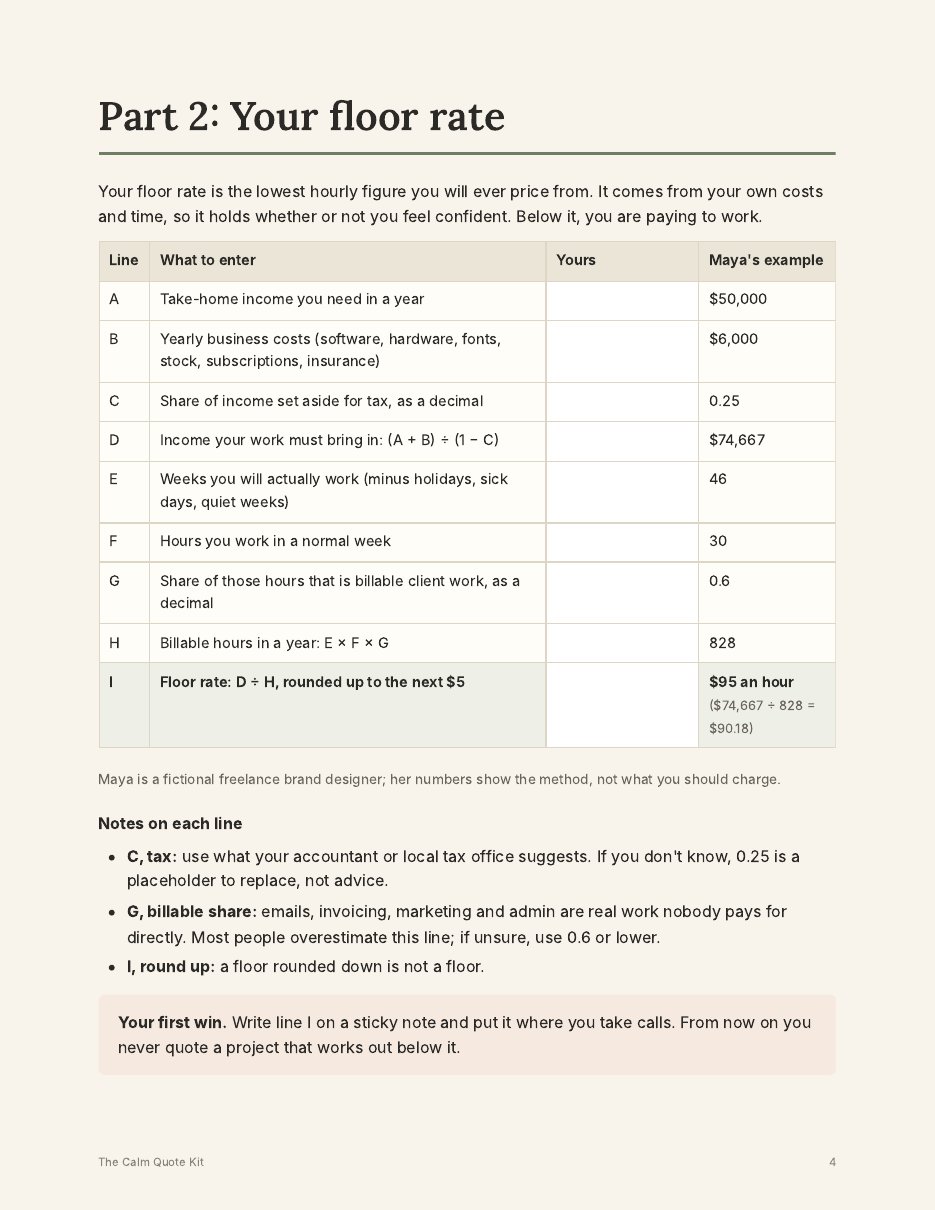
Two full worked examples walk through real-world quotes step by step: a logo for a bakery and a five-page website for a clinic. Every number is shown, from hours to the final three prices.
What's in the kit
Why I created The Calm Quote Kit
As a freelance designer, I know how much pressure can sit inside one simple question: “How much will it cost?”
You’re weighing up the work, thinking about the client’s budget, and trying to give an answer you’ll still feel comfortable with after the call.
That problem led me to create The Calm Quote Kit: a practical way to prepare your numbers before the conversation starts, so the price is already decided when the question comes.
The kit helps you work out your minimum rate, build three packages, and keep your prices and scripts on one page. My aim is to help you go into your next client conversation knowing what you’ll charge, and how you arrived at it.
Alex Rowan
Freelance designer · Creator of The Calm Quote Kit
Alex Rowan is my professional pen name.
The Calm Quote Kit
$27
One underpriced quote costs more than this kit.
Get the kit now14-day refund. Use the kit on one real quote. If it didn't help, email hello@calmquotekit.com within 14 days of buying and you'll get a full refund.
Questions
Will it tell me exactly what to charge?
No one can give you that number from outside. The kit gives you a method to work it out from your own costs, hours and market, and the words to say it.
I'm new to freelancing. Is it too early?
It's a good time to start. The floor rate works from your costs and hours, so it doesn't depend on years of experience. The market check shows you where newer designers usually sit.
I'm not great with spreadsheets.
You don't need to be. You type in a few numbers and the worksheet does the maths. You can also do it on paper with the PDF.
I don't live in the US.
The examples use US dollars, but the method works in any currency. Just enter your own figures.
Is this tax or legal advice?
No. For tax set-asides and contract terms, check with an accountant or lawyer where you live.
What if it doesn't help?
Use it on one real quote. If it didn't help, email within 14 days for a full refund.
Your next client is going to ask the price.
You can decide it on the call, under pressure, like last time. Or you can decide it tonight, calmly, and read it off one page.
Get the kit for $27